
Why Worker-Type Selection Kills Projects Before Work Begins
The problem isn't who you hire. It's the execution architecture you choose without realizing you're choosing it.

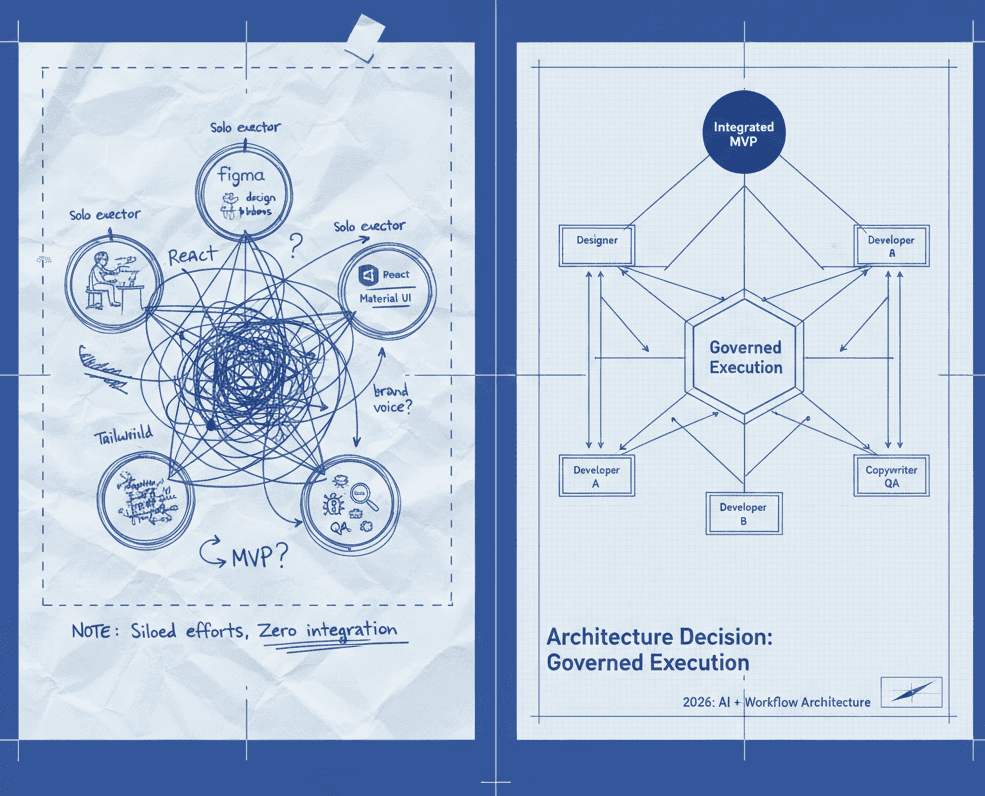
Table of Contents
Share this article
Table of Contents
Share this article
The MVP That Couldn't Ship
A founder I know hired five people to build an MVP last year. A designer. Two developers. A copywriter. A QA tester.
All talented. All busy. All billing.
Four months later, nothing integrated.
Here's what went wrong and no, it wasn't the people.
The designer built a component library in Figma using custom design tokens she'd developed for consistency. Smart move. One developer built the frontend in React using Material UI because it's fast and well-documented. Also smart. The other developer chose Tailwind CSS because he'd shipped three projects with it and knew the system cold. Reasonable. The copywriter wrote for a brand voice somewhere between "friendly startup" and "enterprise serious" because nobody had defined it. She asked once, got a vague answer, and made her best guess.
Four months of individual excellence. Zero integration.
The founder spent the fifth month trying to reconcile component systems that didn't talk to each other, code architectures built on different assumptions, and copy that fit neither.
She told me: "I hired good people. I don't understand what went wrong."
I did. She thought she was making a hiring decision, however, she was actually making an architecture decision and she made it unconsciously, by default, without realizing a decision was being made at all.
The Decision You Didn't Know You Were Making
When founders engage freelancers, agencies, or services, they think they're answering: "Who can do this work?"
That's the wrong question.
The real question is: "What execution structure does this work require?"
Hiring is about capability. Architecture is about how capabilities connect, coordinate, and cohere. You can hire five capable people and still architect a system that guarantees failure.
That's what happened to the founder above. She hired well. She architected unconsciously. The architecture she accidentally chose, five independent nodes with no integration layer was wrong for work that required coordination, shared assumptions, and verified handoffs.
This distinction matters more now than it did five years ago. The explosion of freelance talent, productized services, and AI-augmented work means founders have more execution options than ever. Upwork reported that one in four U.S. skilled knowledge workers now operate independently, generating $1.5 trillion in earnings in 2024. The options have multiplied and it's no news that more options without better decision-making just means more ways to architect failure.
Four Execution Architectures
Whether you realize it or not, help sort out by engaging freelancers, agencies, or services, inevitably means you're choosing one of four structures.
Architecture 1: Solo Executor
One person. One task. Clear boundaries.
This works when the work is self-contained: a logo, a landing page, a specific feature in an already-structured codebase. The solo executor owns a task. They don't own coordination, integration, or the outcome — just their piece.
Good for: Bounded work with clear specs and minimal dependencies.
Fails when: The work requires tradeoffs, iteration, or integration with other pieces.
Architecture 2: Parallel Team
Multiple people working simultaneously, typically with a founder or manager as the coordination point.
This is what the MVP founder accidentally chose. It looks efficient, everyone's working, billing, producing. But, without explicit integration mechanisms, parallel teams produce parallel outputs that may not converge.
Good for: Work that genuinely can be done in parallel with integration handled separately.
Fails when: The founder becomes the only person holding the full picture, which means the founder becomes the bottleneck, the glue, and eventually the burnout risk.
Architecture 3: Service Provider
An external entity delivering output to spec. Design-as-a-service. White-label content. Outsourced development packages.
Services optimize for repeatability and efficiency. When you know exactly what you want, services can be fast and cost-effective.
Good for: Stable specs, repeatable deliverables, minimal iteration.
Fails when: The work requires discovery, judgment, or refinement. Services ask "what do you want?" If you don't know yet, you'll pay for that uncertainty in rework.
Architecture 4: Governed Execution
Explicit milestones. Defined quality gates. Clear ownership of "done." Built-in iteration loops.
This isn't bureaucracy, it's structure that prevents the failure modes of the other three architectures. Someone owns coordination. Someone verifies integration. Someone is accountable for the outcome, not just the activity.
Good for: Outcome-level work where the cost of failure is high and the path isn't fully defined upfront.
Fails when: Overhead exceeds value as simple tasks don't need governance layers.
The pattern I keep seeing: Most founders default to Architecture 1 or 2 because they're fast to set up and feel lean. But Architecture 1 and 2 only work when coordination is either unnecessary or cheap. For outcome-level work i.e., MVPs, product launches, strategic initiatives, the coordination cost is neither.
What Regulated Environments Taught Me
In software delivery particularly the insurance sector: Insurance is unforgiving. Documentation isn't optional. Handoffs aren't informal. When you're building systems that handle claims, compliance, and customer data, "move fast and break things" gets you regulatory incidents and reputational damage.
The environment has taught me something I've watched founders learn the hard way: undocumented architecture decisions become invisible constraints.
In regulated delivery, you cannot afford latent architecture. Every project lifecycle must initiate with an explicit Governance Framework: Is the delivery decentralized (Agile) or centralized (Command & Control)? Who manages the API contracts and Cross-Functional Handoffs? What are the Evidence-Based Gates for UAT (User Acceptance Testing)? What is the protocol for Requirements Drift in a locked-scope environment?
These questions felt like overhead until I saw what happened without them: small misunderstandings compounding into expensive production incidents, handoffs that lost contextual metadata, and talented people building high-performance features that ultimately failed compliance audits because nobody verified architectural alignment.
When I moved into founder life, building other ventures, I watched the same patterns repeat. Smart founders hiring talented people and still failing, not because of capability gaps, but because of architecture gaps.
They were hiring for headcount, while the project required orchestration. In the world of regulated software, if it isn't documented, it doesn't exist. In the world of startups, if the architecture isn't explicit, the product won't scale.
The founders who struggled most were the ones who saw hiring as the decision. The founders who executed well were the ones who saw architecture as the decision and hiring as implementation.
For years, this kind of architectural discipline was only possible in environments where failure had regulatory consequences. That's changing.
2026: Architecture Is Becoming Legible
"Here's why this problem is about to get easier to solve or harder to ignore.
For most of business history, execution architecture was invisible. You made decisions about who to hire, what to outsource, how to structure work, but those decisions lived in your head, in scattered conversations, in implicit assumptions. When projects failed, it was hard to trace failure back to architectural choices because the architecture was never explicit.
That's shifting. The tools emerging now—workflow platforms, AI coordination layers, structured execution environments, are making architecture legible. You can see, in real time, how work is structured, where handoffs happen, who owns what, and where coordination is breaking down.
AI is accelerating this. Not by replacing human judgment, but by handling the verification and tracking that humans do poorly. AI can monitor whether milestones are being met, flag when parallel workstreams are diverging, surface assumptions that haven't been aligned. The architectural decisions that used to be invisible are becoming observable.
This changes the game for founders. The question isn't whether to think architecturally, it's whether you'll make architecture decisions consciously or let them happen by default.
The founders building execution advantages in 2026 aren't necessarily hiring better people. They're making better architecture decisions explicitly and upfront, with awareness of what each structure enables and constrains.
The Pre-Project Audit
Before your next project, take ten minutes to make your architecture decision consciously.
Question 1: What am I actually buying?
A task? A deliverable? An output to spec? An outcome?
Be honest. A logo is a task. An MVP is an outcome. Don't choose task-level architecture for outcome-level work.
Question 2: Where does coordination live?
If coordination lives in your head (if you're the only one who sees how pieces connect) you've chosen Architecture 2 whether you meant to or not. And you've made yourself the constraint.
Question 3: Who owns "done"?
If you own "done" (if you're the one checking quality, verifying integration, deciding when something is complete) you are the governance layer. That might work for a two-week sprint. It won't work for a six-month initiative.
Question 4: What happens when requirements change?
Because they will. If your architecture assumes stable requirements, you're building in fragility. If your architecture includes iteration mechanisms, you're building in resilience.
The Shift
The founder with the failed MVP didn't have a talent problem. She had an architecture problem she didn't know she was choosing.
Five talented people, working in parallel, with no integration layer, no shared assumptions, no verified handoffs. That architecture guarantees divergence. It's not a risk, it's a structural feature.
When she rebuilt, she didn't hire different people. She chose a different architecture. Explicit coordination mechanisms. Defined integration points. Milestone verification. The same caliber of talent, structured to converge instead of diverge.
The second attempt shipped.
If your projects keep stalling despite good people, the diagnosis probably isn't capability. Look at your architecture. Look at the decisions you made, or the decisions that got made by default because you didn't make them consciously.
Before your next project, pause. You're not just hiring.
You're architecting.
Related Articles
Continue exploring workforce technology insights




Never Miss an Insight
Subscribe to our newsletter for the latest workforce technology insights, research findings, and practical guides delivered to your inbox.