
is it too early to hire a senior engineer at seed stage
The roadmap is growing. Investors are asking about delivery speed. Your current engineers are stretched, and someone in your last board meeting floated the idea of bringing in a senior engineer to accelerate things. It sounds logical. It might even be right. But most seed-stage founders eventually face this decision without a clear framework for making it and the wrong call in either direction is expensive. Hire too early and you're burning runway on a salary before the role has real work to justify it. Wait too long and you lose quarters of execution velocity you can't get back. The honest answer isn't yes or no. It depends on one question.


Table of Contents
Share this article
Table of Contents
Share this article
IS IT TOO EARLY TO HIRE A SENIOR ENGINEER AT SEED STAGE ?
The roadmap is growing, Investors are asking about delivery speed. Your current engineers are stretched, and someone in your last board meeting floated the idea of bringing in a senior engineer to accelerate things. It sounds logical. It might even be right.
But most seed-stage founders eventually face this decision without a clear framework for making it and the wrong call in either direction is expensive. Hire too early and you're burning runway on a salary before the role has real work to justify it. Wait too long and you lose quarters of execution velocity you can't get back.The honest answer isn't yes or no. It depends on one question.
WKforce gives funded early-stage startups governed execution capacity that ships on their roadmap , without the cost, time, or risk of a full-time hire. If you need to move faster now, explore wkforce.io
The Honest Answer Depends on One Question
The hiring decision doesn't hinge on how much you've raised or how big your team is. It hinges on the nature of the work itself.
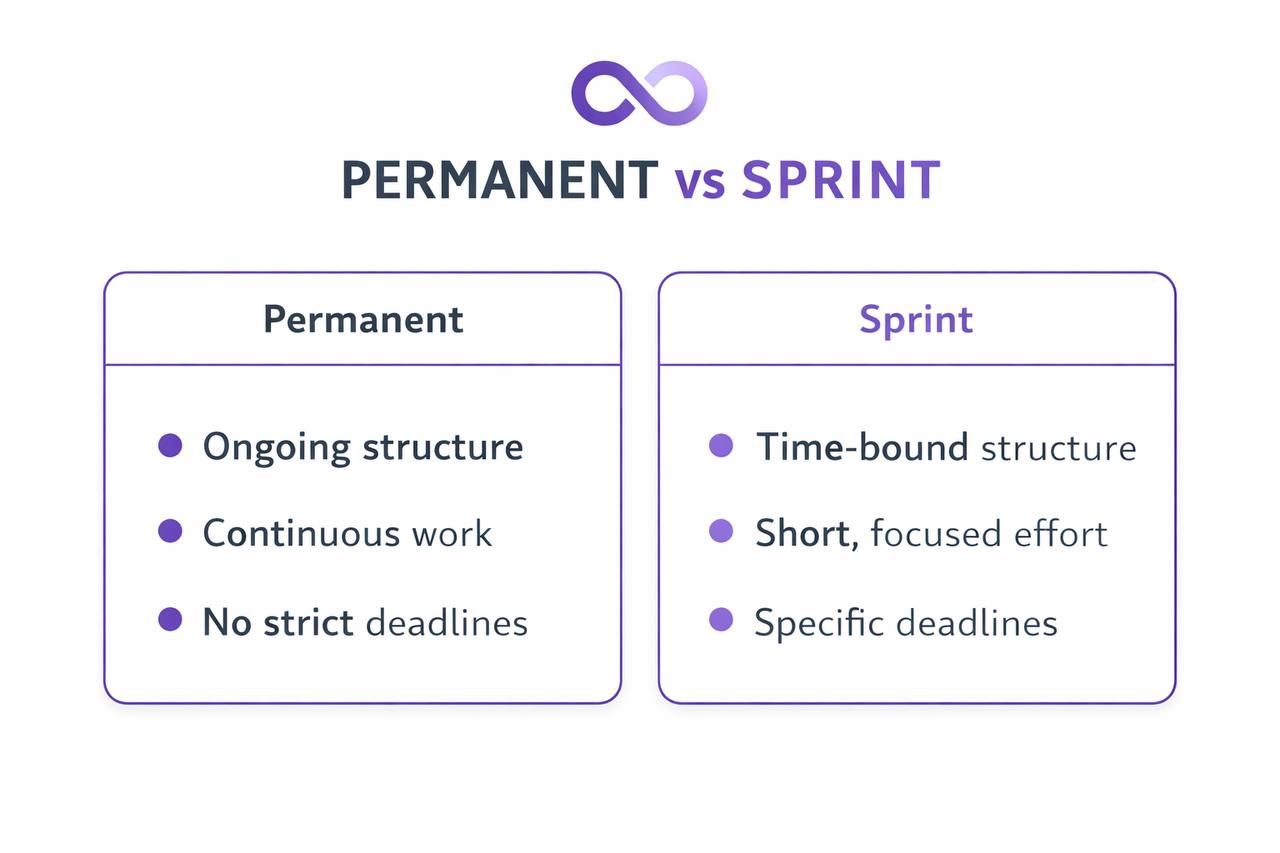
Is this a permanent execution need or a sprint-level execution need?
These are two fundamentally different problems with two fundamentally different solutions.
A permanent execution need looks like this:
- The work shows up in every sprint, consistently
- The role requires long-term architectural ownership
- The time horizon is 18 months or more
- A clean handoff at the end isn't realistic , this work compounds over time
A sprint-level execution need looks like this:
- The work is time-bound and milestone-specific
- The deliverable has a natural end point
- The need is immediate, the team can't wait 90 days
- The scope is clear enough to define, deliver, and hand off
Most founders skip this distinction entirely. They see a gap in execution and immediately map it to headcount. What startups often discover the hard way is that the gap was temporary and the hire wasn't.
When the Answer Is Yes = Hire
There are situations where hiring a senior engineer at seed stage is absolutely the right call. Don't let anyone tell you otherwise.
Hire when these signals are present:
- The skill will be needed in every sprint for the next 18 months or more
- The role requires long-term architectural ownership decisions that compound over time
- You're building a core technical foundation that needs internal stewardship
- Your runway comfortably absorbs a 60–90 day hiring process plus a 30-day ramp period
- The work can't be scoped cleanly enough to hand off to an external team
A fintech startup building proprietary payments infrastructure needs a senior engineer who owns that codebase permanently. That's not a sprint. That's a foundation. Hire.
A seed-stage SaaS team building core authentication, API architecture, or data pipeline infrastructure that will underpin everything else for the next two years, same answer. Hire.
The cost of the right full-time senior hire is justified when the need is permanent. The mistake isn't hiring a senior engineer. The mistake is hiring one for a sprint-level problem.
When the Answer Is No = Sprint It
Now for the harder conversation , the one most hiring advice avoids.
There are situations where bringing in a full-time senior engineer is the wrong move, at least right now. Recognising them early saves runway, preserves equity, and gets the work done faster than a 90-day search ever would.
Hold the hire when these signals are present:
- A specific backlog milestone needs to ship in the next 30–60 days
- The roadmap is still evolving , scope is likely to shift before a new hire ramps up
- You need execution capacity immediately, not in three months
- The role is difficult to define clearly enough to recruit against
- The work has a natural end point, a feature launch, a migration, a version release
Hiring a senior engineer means:
- 60–90 day search timeline before anyone starts
- 30-day ramp period before full contribution
- Salary, benefits, and equity from day one
- A long-term headcount commitment on the books
- Sprint-level execution capacity means:
- Operational within days, not months
- Structured delivery from sprint one
- You pay for what ships, not for availability
- The engagement ends cleanly at the milestone
One seed-stage team spent eleven weeks recruiting for a senior backend engineer to deliver a specific API integration needed for a key enterprise client. By the time the hire started, the client had extended their trial deadline twice and confidence was eroding. The work was a defined milestone. It didn't need a permanent hire. It needed structured execution capacity for eight weeks.
Some startups handle sprint-level execution gaps through structured external delivery support. WKforce is one option worth exploring wkforce.io
The Question to Ask Before You Decide
Before you open the role, write the job description, or brief a recruiter , stop and answer this honestly:
"Is this a permanent execution need or a sprint-level execution need?"
It sounds simple. Most founding teams don't actually answer it before they start hiring. They respond to pressure, from investors, from a growing backlog, from the feeling that something needs to change and the hiring process begins before the diagnosis is done.
If the work will be needed in every sprint for the next 18 months, you need a hire. If the work is a defined milestone with a natural end point, you need execution capacity and a hire is the slowest and most expensive way to get it.
What the Alternative Looks Like
For sprint-level execution needs, a governed delivery pod provides the capacity without the commitment.
Unlike a freelancer or contractor arrangement:
Scope and acceptance criteria are defined before work begins not assumed, management overhead is low , accountability is milestone-based, not task-based, payment is tied to milestone approval, not hours logged
The pod works inside your existing repo, board, and standards not parallel to them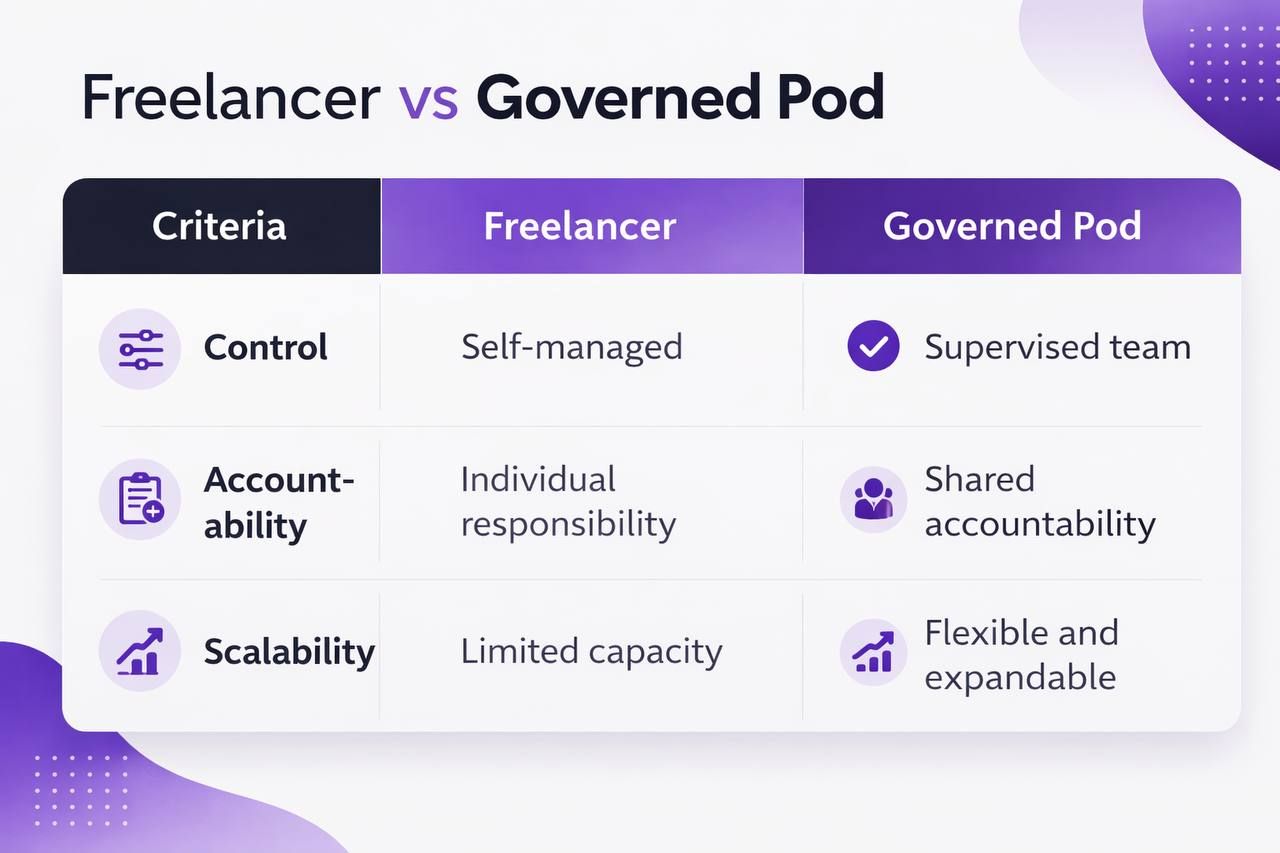
Unlike a full-time hire:
No recruiting timeline, operational within days, no ramp period eating into delivery time
No permanent headcount commitment when the need is temporary, engagement ends cleanly when the milestone is delivered.
It's not a replacement for a full-time hire when a full-time hire is the right answer. It's a faster, leaner path to execution when the work is bounded, immediate, and doesn't require permanent ownership.
The mistake many teams make is treating these as competing options. They're not. They solve different problems.
Frequently Asked Questions
Q: How much does it typically cost to hire a senior engineer at seed stage?
A: Total compensation for a senior engineer , salary, benefits, payroll taxes, and equity , commonly runs between $180,000 and $280,000 annually in major markets, depending on location and stack. Factor in 60–90 days of recruiting time and 30 days of ramp before full contribution, and the real cost of a hire is closer to 12–14 months of productive output for every year on payroll. That math works when the need is permanent. It doesn't when the need is a defined milestone.
Q: What if I'm not sure whether the need is permanent or sprint-level?
A:That uncertainty is itself a signal. If you can't clearly describe what the engineer will be working on in month seven or month twelve, the need is probably not permanent yet. Write out the work. If it has a natural end point, a feature launch, a migration, a version release ,it's a sprint-level need. If it bleeds into everything the team builds from here forward, it's permanent.
Q: Can a governed delivery pod handle complex or senior-level engineering work?
A: Yes, provided the scope is well-defined and acceptance criteria are clear upfront. Complexity isn't the limiting factor,Clarity is. A governed pod with a well-scoped milestone can deliver senior-level work on a defined problem. What it isn't designed to replace is long-term architectural ownership , the kind of judgment that compounds over 18 months of working inside a codebase.
Q: What happens after the sprint-level need is delivered , do I still need to hire?
A: Sometimes yes, sometimes no. Some startups find that a well-delivered sprint resolves the immediate gap and the team can carry forward from there. Others use the sprint to validate that a permanent role is now justified , the work exists, the scope is clear, and the hire is easier to define and recruit for. Either way, the sprint buys you clarity that rushing a hire under pressure doesn't.
Q: How long does it take to get a governed delivery pod up and running versus hiring?
A: A governed pod can be operational within days scoped, structured, and integrated into your existing sprint cycle. A senior engineering hire, realistically, takes 60–90 days to recruit and another 30 days to ramp. If your execution need is immediate, that timeline alone often answers the question.
Q: Is using external execution capacity a sign that the team isn't strong enough?
A: No. It's a sign that the team is being used correctly. Strong internal engineers should be focused on the work that requires long-term ownership and institutional knowledge. Defined, bounded execution gaps, a feature build, an integration, a backlog sprint , don't require permanent headcount. Using governed external capacity for those gaps keeps your core team focused on what only they can own.
Conclusion
Hiring a senior engineer at seed stage isn't inherently too early and it isn't inherently the right move. It depends entirely on whether the need is permanent or temporary.
Permanent execution need with 18+ months of runway justification? Hire. Do it well. Take the time to find the right person.
Sprint-level execution gap that can't wait 90 days? Don't burn runway and calendar on a hiring process for a milestone problem.
The framework is simple. The discipline to apply it before the pressure builds ,that's the harder part.
If it's a sprint-level you need wkforce.io
Related Articles
Continue exploring workforce technology insights




Never Miss an Insight
Subscribe to our newsletter for the latest workforce technology insights, research findings, and practical guides delivered to your inbox.