
The Future of Hiring in Africa: Why Workforce Solutions Are Replacing Traditional Recruitment
Hiring in Africa is changing fast. As skills gaps widen and traditional recruitment slows businesses down, workforce solutions are emerging as a smarter way to hire, deploy, and develop talent. This article explores why skills-first, outcome-driven workforce models are replacing old hiring systems and what it means for companies and talent across Africa.

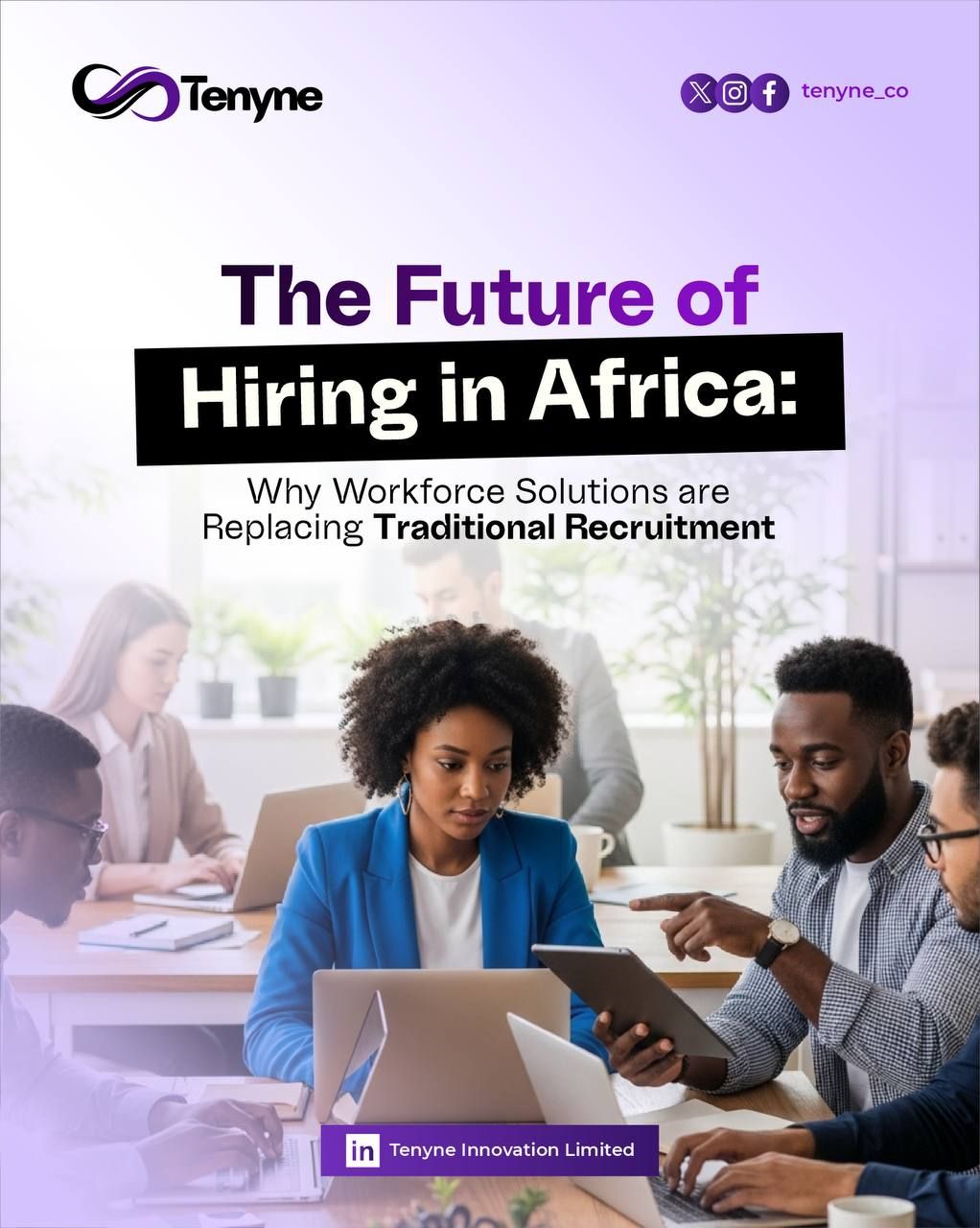
Table of Contents
Share this article
Table of Contents
Share this article
The Future of Hiring in Africa: Why Workforce Solutions Are Replacing Traditional Recruitment
A Lagos-based fintech startup recently spent eight weeks trying to hire a data analyst through traditional methods. By the time they finally made an offer, their project timeline had slipped, and two potential clients had moved to competitors. The cost? Over $6,000 in recruitment expenses and lost revenue opportunities.
This isn’t an isolated incident. It’s the new reality of traditional hiring in Africa’s fastest-growing markets.
The Traditional Hiring Crisis
While many HR teams still rely on posting job ads, screening resumes, and conducting lengthy interview cycles, hiring has slowed amid economic challenges and skills mismatches. The system is breaking down because it assumes:
• Skills are static and degrees equal job readiness
• Linear processes work across all industries
• Time-to-hire doesn’t impact business outcomes
But today’s African workforce operates differently. Africa’s GDP growth is predicted to average 3.8% in 2024 and 4.2% by 2025, exceeding global averages. In markets growing this rapidly, waiting weeks or months for talent isn’t just inefficient, it’s competitive suicide.
The Real Cost of Getting It Wrong
Recruitment Cycles That Kill Momentum
The average cost per hire in the United States is around $4,700. In Africa’s emerging markets, unfilled positions carry significant productivity costs, which can vary by industry and company size. Every week a role remains vacant delays projects and can reduce revenue opportunities. For African SMEs, where margins are tighter, these delays can be catastrophic.The Skills Mismatch Problem
Here’s the uncomfortable truth: CVs don’t reflect actual capability. Skills gaps remain one of the largest barriers to business transformation globally, as documented by the World Economic Forum. A marketing candidate might have “3 years of digital marketing experience” on paper but struggle to execute a basic campaign or measure ROI. In Nigeria, a large portion of youth face gaps in foundational digital skills, creating a mismatch between credentials and competence.High Turnover and Hidden Costs
Bad hires don’t just waste recruitment budgets. They consume onboarding time, training resources, and team morale. Internal surveys show that many SMBs underestimate hiring costs, often missing factors like lost productivity during vacancy periods and opportunity costs of management time.Zero Flexibility for Growth
Almost half of Sub-Saharan African employers see talent availability improving in 2025–2030, yet traditional hiring models assume static workforces. When project demands fluctuate and they always do companies need agile solutions, not rigid headcount structures.
The Workforce Solution: A Strategic Shift
Workforce solutions aren’t just tools, they represent a fundamental shift from filling positions to delivering outcomes.
Approach 1: Skills-First Hiring
Forget resumes. Assess candidates on demonstrated ability through real projects and practical assessments.
The Skills-First Framework:
- Define specific project outcomes (not job descriptions)
- Identify required competencies (not credentials)
- Validate candidates on actual deliverables
- Deploy talent ready to contribute from day one
This approach eliminates the guesswork of traditional resume screening.
Approach 2: Outcome-Driven Team Building
Stop hiring for job titles. Start assembling teams for deliverables.
Break large initiatives into mini-outcomes:
• Increase Instagram engagement by 20% in 30 days
• Reduce customer support response time by 50% in 6 weeks
This model aligns perfectly with employers’ plans to prioritize workforce development, with 85% planning to focus on upskilling by 2030 (WEF Future of Jobs Report).
Approach 3: Continuous Capability Development
By 2030, 39% of workers’ core skills are expected to change. Traditional hiring assumes skills are permanent. Workforce solutions treat capability building as continuous.
Example: Forward-thinking companies implementing continuous upskilling programs report faster response times and improved customer satisfaction when employees gain new technical capabilities and see clear career progression.
Approach 4: Flexible Talent Models
Africa’s informal employment rate is around 85%, meaning rigid full-time models miss vast talent pools. Mix full-time employees with contractors, gig workers, and trained interns who can scale up or down based on project needs.
Practical Application: Companies adopting dynamic talent allocation see idle time drop significantly and projects finish ahead of schedule because talent is matched based on skills and availability, not fixed job descriptions.
What the Data Really Shows
• Talent PEO Africa witnessed a 38% surge in hiring inquiries compared to the last quarter of 2024
• Nigeria has a youthful population, with around 70% under age 30 (WEF 2025)
• Growing demand for network and cybersecurity skills, with 87% of Nigerian employers expecting increased demand by 2030
• Africa’s staffing market is expected to reach $32.18 billion by 2031
The opportunity is enormous. The question is whether your hiring approach can capture it.
Addressing the Skeptic
Workforce platforms are too complicated.
Reality: Platforms like WKforce simplify HR by automating screening, reducing bias, and handling administrative tasks, freeing HR teams to focus on strategy.
Small companies can’t afford these platforms.
Reality: Modern workforce solutions scale for businesses of all sizes. Even startups can access validated talent for projects without committing to full-time headcount.
This only works for tech roles.
Reality: Workforce solutions work across marketing, finance, operations, HR, customer service, and more — any role requiring measurable outcomes benefits from skills-first deployment.
Your Action Plan
If you're still relying solely on traditional hiring in 2025, you're competing with one hand tied behind your back. Here's how to start shifting:
- Audit your current cost per hire – Include hidden costs like lost productivity and management time
- Pilot a skills-first approach – Test skills validation on your next hire
- Build a talent pipeline strategy – Continuously identify and validate candidates
- Implement continuous upskilling – Make capability development ongoing
- Track outcomes, not activities – Measure results delivered, not just time spent
The Bottom Line
59% of the global workforce will need reskilling by 2030, with 11% unlikely to receive it. In Africa, where 71.7% of young workers aged 25 to 29 are in informal or insecure employment, this gap represents both a massive challenge and an unprecedented opportunity.
Traditional hiring is slow, expensive, and misaligned with how African businesses actually operate. The future belongs to companies that can validate skills, deploy talent efficiently, and build predictable hiring systems that don't require constant hand-holding.
The companies thriving in Lagos, Nairobi, Accra, and beyond aren't the ones with the best job postings. They're the ones who've reimagined talent as a strategic capability they can develop, deploy, and scale on demand.
Introducing WKforce: The Skills-First Solution
This is exactly why we're building WKforce, a skills-first talent platform designed to fix broken hiring systems once and for all.
WKforce solves the core problems keeping companies stuck in traditional hiring cycles:
• No more resume guessing games – Connect with candidates validated through practical projects
• Stop wasting founder time – Eliminate endless screening and hand-holding
• Predictable, repeatable hiring – Build consistent talent pipelines
• Skills that match real needs – Focus on what candidates can actually do
Whether you're an enterprise building future-ready teams or a startup that needs to hire fast without sacrificing quality, WKforce gives you ready-to-work talent validated on actual skills, not paper credentials.
For early-career professionals and students, WKforce provides a way to prove your abilities and get matched with companies looking for exactly what you can deliver, no more getting lost in resume black holes.
We're currently building something that will transform how African companies and talent connect. Join the waitlist today to be among the first to access a hiring system that actually works, one that's efficient, skills-driven, and designed for the way modern businesses operate..
👉 Join the WKforce Waitlist – Be part of the future of hiring in Africa.
Related Articles
Continue exploring workforce technology insights





Never Miss an Insight
Subscribe to our newsletter for the latest workforce technology insights, research findings, and practical guides delivered to your inbox.